
The Future Pioneered by the ENEOS Group: Our HR Strategy to Ensure Every Employee Performs Their Best - Part 2
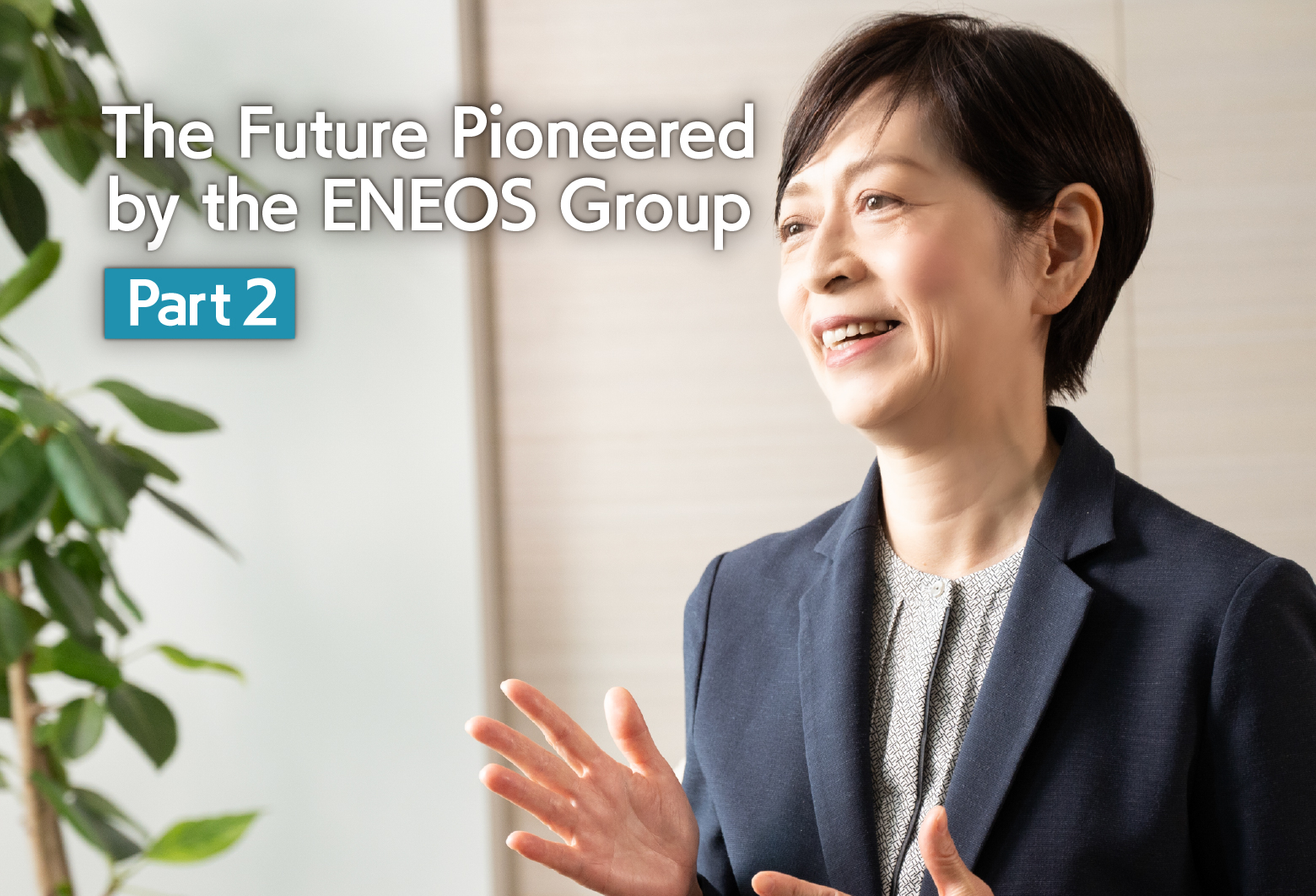
The ENEOS Group, which employs over 40,000 people, is revolutionizing its HR strategy. Under an environment with growing uncertainty, the Group is striving to adapt itself more flexibly. It aims to tone up its management structure by implementing job-based talent management that assigns the right job to the right person and human capital management initiatives based on fostering a corporate culture where employees can work comfortably and with pride. In this three-part series, we asked Funo Atsuko, Chief Human Resource Officer (CHRO), who is leading the Group-wide transformation, about how the relationship between the company and its employees will change under the new HR strategy, and what kind of people the Group is seeking.
Part 2: Matching the Right People to All Posts Essential for Realizing Our Strategy
Job-based talent management that assigns the right job to the right person and a development process based on a clear definition of leadership ideals
――What are the ENEOS Group’s ideals for its employees and companies, and the relationships between them?
Funo: The ENEOS Group currently has over 40,000 employees. I know that they all have their own reasons for joining the Group, but we’ve never clarified what they expect from the company. I’m sure many of them aren’t just here for a paycheck, but instead they wanted job satisfaction and had hopes for how the Group would help them grow. As a company, we want to give these people opportunities and environments in which they can shine and perform at their best. And we want them to get results. I’d like to emphasize that companies and their employees provide value to each other. It’s an extremely equal relationship in which they choose and are chosen by each other.
――I’ve heard about assigning “the right person to the right job,” but you’ve been talking about assigning “the right job to the right person.” How do those differ?
Funo: I think when you assign “the right person to the right job,” you’re simply assigning any person into an existing operation. But in the ENEOS Group, first, we decide what operations are necessary to realize the Group Philosophy and management strategy, and the tasks required to realize them, and then we find the people who are best suited to those positions. That’s why we intentionally say “the right job to the right person.” The key to this is specialization, which is why we introduced a job-based talent management that leverages the experience, knowledge, and skills of each employee. This has enabled us to support every single position that is vital for realizing the Group Philosophy and management strategy through people who can perform to their full potential.
――What are the advantages for the employees of the ENEOS Group?
Funo: The new system provides three forms of visualization for employee careers. First, as I mentioned are the operations (or posts) that are essential. Second are the skills, experience, and knowledge. Knowing these two makes it possible to identify gaps between the goals you want to reach and where you are now. Thirdly, we also provide career paths to bridge these gaps. With these three forms of visualization, employees can select their own career goals and career paths based on their skills and expertise. They can enhance their value through consulting with their supervisors and utilizing company training programs.
――What are your thoughts on developing leaders?
Funo: Neither the experience and skills of leaders in the ENEOS Group, nor the requirements from the Group to them have been clearly defined. So, in FY2024, we began defining them, starting with executives. Management isn’t handled by a single person, it’s done by a team. Visualizing the power of the team has reaffirmed for me the importance of selecting team members, and developing leaders that maximize the power of the team. In FY2025, we did this even more systematically by visualizing the leadership of people in managerial and higher positions. We created and ran mechanisms for discussing the selection and development of leaders, starting at the operating company level and extending to the leaders that will be responsible for the future of ENEOS Holdings. There were areas where leadership selection standards were vague, but going forward we’d like to select leaders using more transparent and objective Group-wide criteria. We’d also like to be able to provide reasonable explanations for those decisions. That said, leadership standards are not perennial. They change with the times. Needless to say, what’s required of a leader at stable times is different from what’s required during times of significant change, like now. Even in the same environment, the tasks involved in carrying out precise operations differ from those involved in blazing a trail into the unknown. I want to clearly define and visualize these leadership ideals.
――What kinds of changes would you like to see in ENEOS Group employees, given these tremendous changes to career development and the Group’s leader selection systems?
Funo: The first thing I’d like to ask of employees is to connect their own jobs with the Group Philosophy and the importance of the Group to society. As I explained, we’ve formulated a management strategy for realizing the Group Philosophy, but it’s ultimately our people that will implement it. Each employee needs to see the company’s mission as their own. Another thing is that the company and its employees are equal and mutually enhance each other’s value, so I’d like to see employees take advantage of the opportunities provided by the company to maximize their own abilities. Also, nobody knows what you’re thinking if you don’t say anything, so I hope our employees will develop a strong mindset of speaking out regardless of hierarchy, and engaging in constructive discussions to work better. In short, I want employees to see all of this as something that affects themselves and to work ambitiously to increase their own value.
――You mentioned the importance of communication. As CHRO, what kind of dialogue would you like to engage in with employees?
Funo: In Part 1, I talked about how a CHRO is responsible for thinking about the ENEOS Group’s people strategy. If I don’t know the realities of the frontline, I can’t develop effective strategies, so I’d like to actively engage in dialogue with more employees. I feel like employees have a wealth of different opinions on our people strategy. We might not agree on everything, but I’d like our people to say what we need to be said and engage in constructive debate. I look forward to having such occasions.
―― Thank you. In the next part, I’d like to ask you about the shaping of the ENEOS Group’s corporate culture.
■Summary
This article discussed the ENEOS Group aiming for the company and its employees to be equal, both choosing and being chosen by each other. We talked about how one of the company’s roles is to provide employees with growth opportunities through job-based talent management and one of employees’ roles is to use these opportunities to develop their own careers and contribute to the company. We also touched on changes in the systems used to select leaders. In the next part, we’ll delve more deeply into fostering a corporate culture where employees can work comfortably and with pride. Don’t miss it.
→Continued in Part 3: The Future Pioneered by the ENEOS Group: Our HR Strategy to Ensure Every Employee Performs Their Best - Part 3 | ENEOSWAYS | ENEOS Holdings


Related Posts
A leader in the energy industry, ENEOS is also at the forefront of the industry in utilizing artificial intelligence (AI), achieving the world’s first automated operation of a crude oil processing unit at the Kawasaki Refinery in 2024. ENEOS is strengthening four driving forces—(1) data utilization, (2) digital technology capabilities, (3) digital and IT personnel, and (4) security—to seek “Tomorrow’s Normal with AI” that achieves operational transformation and value creation. In this three-part series, we asked Tanaka Tsukasa, leader of ENEOS’s digital strategy and General Manager of IT Planning & Development Department, about the current state of AI utilization and “tomorrow’s normal.”
A leader in the energy industry, ENEOS is also at the forefront of the industry in utilizing artificial intelligence (AI), achieving the world’s first automated operation of a crude oil processing unit at the Kawasaki Refinery in 2024. ENEOS is strengthening four driving forces—(1) data utilization, (2) digital technology capabilities, (3) digital and IT personnel, and (4) security—to seek “Tomorrow’s Normal with AI” that achieves operational transformation and value creation. In this three-part series, we asked Tanaka Tsukasa, leader of ENEOS’s digital strategy and General Manager of IT Planning & Development Department, about the current state of AI utilization and “tomorrow’s normal.”
A leader in the energy industry, ENEOS is also at the forefront of the industry in utilizing artificial intelligence (AI), achieving the world’s first automated operation of a crude oil processing unit at the Kawasaki Refinery in May 2024. ENEOS is strengthening four driving forces—(1) data utilization, (2) digital technology capabilities, (3) digital and IT personnel, and (4) security—to seek “Tomorrow’s Normal with AI” that achieves operational transformation and value creation. In this three-part series, we asked Tanaka Tsukasa, leader of ENEOS’s digital strategy and General Manager of IT Planning & Development Department, about the current state of AI utilization and “tomorrow’s normal.”