
The Future Pioneered by the ENEOS Group: Utilization of AI to Transform Operations and Create New Value - Part 2
A leader in the energy industry, ENEOS is also at the forefront of the industry in utilizing artificial intelligence (AI), achieving the world’s first automated operation of a crude oil processing unit at the Kawasaki Refinery in 2024. ENEOS is strengthening four driving forces—(1) data utilization, (2) digital technology capabilities, (3) digital and IT personnel, and (4) security—to seek “Tomorrow’s Normal with AI” that achieves operational transformation and value creation. In this three-part series, we asked Tanaka Tsukasa, leader of ENEOS’s digital strategy and General Manager of IT Planning & Development Department, about the current state of AI utilization and “tomorrow’s normal.”
Part 2: ENEOS’s DX Promotion and Security Measures
Developing 1,500 advanced digital human resources and the core system “CoMPASS” for data-based management
――ENEOS formulated a digital strategy in FY2023 and embarked on a new digital strategy in FY2025. Please tell us more about the development of digital human resources, an initiative carried on from the previous strategy. ENEOS > Corporate Profile > ENEOS’s Digital Strategy (in Japanese)
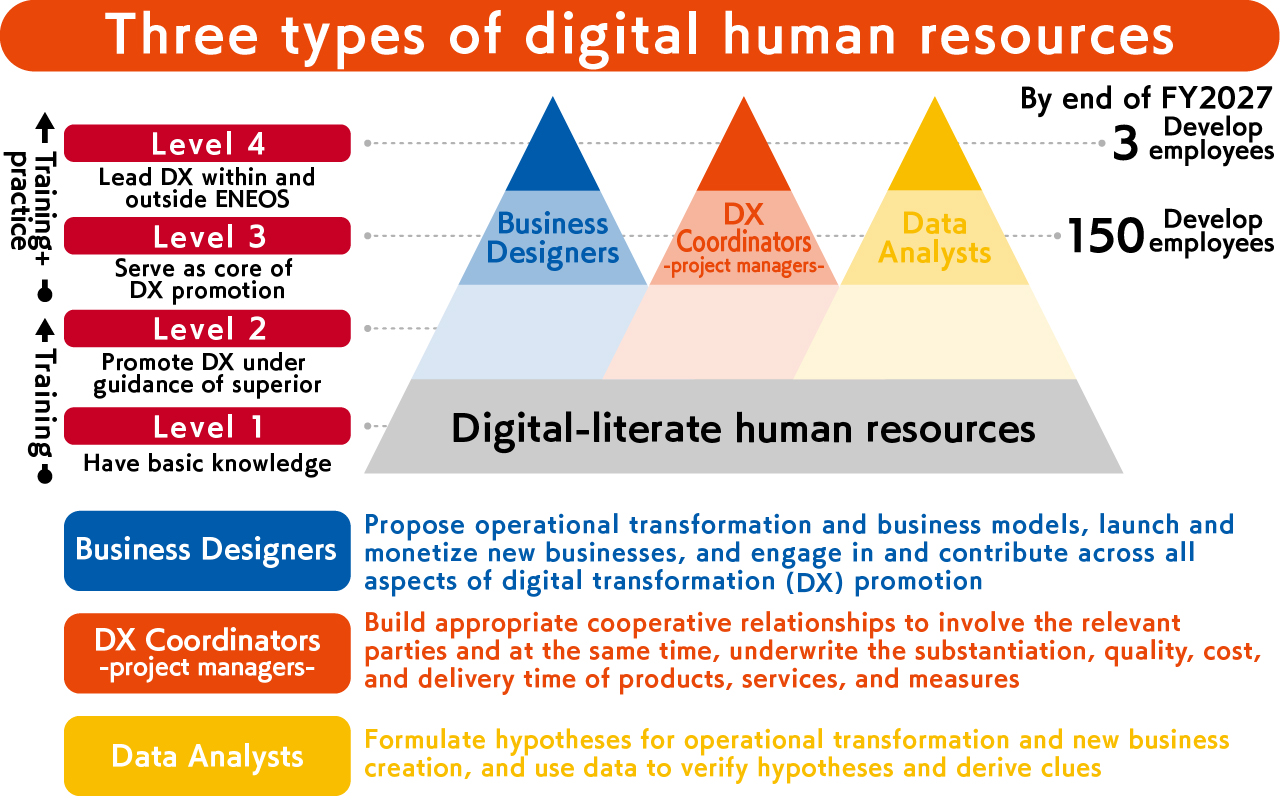
Tanaka: Just like data analysis, we thought it was necessary to develop human resources that can learn about the kind of digital technologies appropriate in the conduct of business and actually select and implement the appropriate technologies. Therefore, in FY2023, we launched a three-level certification system. We carried out certification through a program where we first used e-learning to raise all employees to Level 1, and those who undergo further training are given Level 2 certification. Employees who undertake a certain level of practical work are recognized with Level 3 certification. We achieved our target of developing 1,500 advanced digital human resources—those with at least Level 2 certification—more than a year ahead of our initial plan. This number is equivalent to 20% of all employees.
――That's such a revolutionary approach. These 1,500 advanced digital human resources aren't necessarily IT experts, right?
Tanaka: There were employees who had never been involved in developing systems or implementing digital technologies. We also received requests from the departments about their desire to develop certain employees as digital human resources. Therefore, we narrowed down the scope while communicating with the departments. As we seek operational transformation using digital technologies, rather than people who studied IT at universities and such, we want to provide tools and skills to employees with an awareness of issues and a desire for transformation. By the way, we also have Level 4 certification, although no one has attained it yet. Around 50 employees have achieved Level 3 certification.
――I hear that there are many companies struggling with the securing and development of digital human resources. What are the reasons that ENEOS was able to develop this number of human resources in a short period of time?
Tanaka: The executive in charge back then was former Executive Vice President Shiina Hideki (presently president of Osaka International Refining Company, Limited), who was also the chief digital officer (CDO). Within the CDO Office, a team was created under the momentum of his passionate tutelage, showing how much operations can change through digitalization. I think this was one reason. Efforts were steadily undertaken to generate interest in digital technologies, including the regular dissemination of CDO message videos. Even so, the CDO Office Group can't cover the entirety of ENEOS. I recognize that the cooperative support of members from other groups within the IT Planning & Development Department led to our results in the development of digital human resources.
――Data utilization is another theme that is common across the old and new digital strategies. What are the initiatives for this theme?
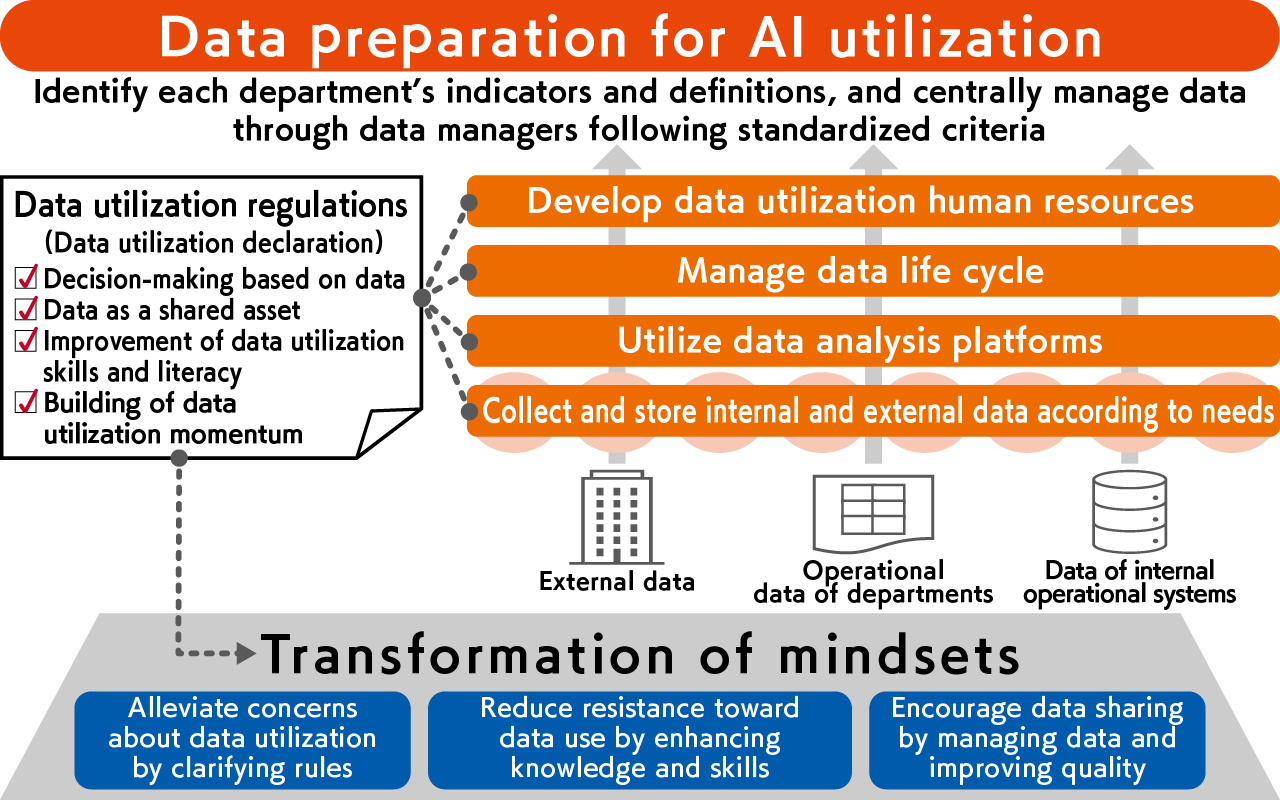
Tanaka: To use data in management, we switched to SAP for our enterprise resource planning (ERP) system and developed CoMPASS as our core system. Aiming for data-driven management in the future, we undertook a variety of preparations, such as storing data in data warehouses to allow utilization. We mainly engage in business-to-business fields, and if we're to expand into business-to-business-to-consumer and business-to-consumer fields, there's an extremely important hurdle of personal information. We hope to offer recommendations that allow greater data utilization and optimal operational execution while clearing this hurdle properly. Honestly, I feel we're still not there yet.
――Has ENEOS already embarked on data utilization?
Tanaka: Yes. We've already been optimizing vessel allocation in the past, and we're now working on putting in place an environment for data utilization, such as carrying our behavior analysis for marketing targeting each individual customer.
――What issues were you referring to when you said we're “still not there yet”?
Tanaka: We're aiming for data-driven management, yet the people in our corporate departments at our head office in Otemachi continue to work hard on generating the required data and materials for briefings and such to management while staring at Excel and PowerPoint. It's an urgent task to address this and create an environment that gives the management a better overview of the entire company.

――Another matter that I want to bring up is cybersecurity. In recent years, there has been an increase in cyberattacks on Japanese companies, creating major problems and social issues. What are the security measures being implemented by ENEOS?
Tanaka: We carefully monitor how our security investments compare to other companies, and I think we invest a larger amount compared to others because we're responsible for a critical infrastructure. Fortunately, so far, we've not had any security incidents with severe impact on business. Even so, we regularly conduct training in anticipation of our response when something happens. Within the IT Planning & Development Department, we have the Cybersecurity Group that specializes in security measures and also leads in providing information and solutions to operating companies within the ENEOS Group. Our Group is responsible for a critical infrastructure of society, and we're making whatever preparations we can to prevent security incidents, since even one such incident can be catastrophic.
――Does this mean that ENEOS’s IT Planning & Development Department plays a leadership role for the ENEOS Group in cybersecurity?
Tanaka: It does. The team in charge goes to every corner of the ENEOS Group for thorough implementation of uniform cybersecurity. I'm grateful to the staff members, who work really hard, going immediately to anywhere that has an issue.
――From listening to you, I can see that the people of the IT Planning & Development Department are going about energetically on the development of digital human resources and cybersecurity. In the next part, we'll talk about “Tomorrow’s Normal with AI” that ENEOS seeks.
■Summary
This article looked at the development of digital human resources, which serve as pillars of ENEOS’s digital strategy, and the initiatives for data utilization. It also touched on the current state of cybersecurity measures, which can have a severe impact on management for ENEOS given its role in the critical infrastructure of society. The next part will explore “Tomorrow’s normal utilizing AI” that ENEOS seeks. Don’t miss it!
→Continued in Part 3: The Future Pioneered by the ENEOS Group: Utilization of AI to Transform Operations and Create New Value - Part 3 | ENEOSWAYS | ENEOS Holdings


Related Posts
A leader in the energy industry, ENEOS is also at the forefront of the industry in utilizing artificial intelligence (AI), achieving the world’s first automated operation of a crude oil processing unit at the Kawasaki Refinery in 2024. ENEOS is strengthening four driving forces—(1) data utilization, (2) digital technology capabilities, (3) digital and IT personnel, and (4) security—to seek “Tomorrow’s Normal with AI” that achieves operational transformation and value creation. In this three-part series, we asked Tanaka Tsukasa, leader of ENEOS’s digital strategy and General Manager of IT Planning & Development Department, about the current state of AI utilization and “tomorrow’s normal.”
A leader in the energy industry, ENEOS is also at the forefront of the industry in utilizing artificial intelligence (AI), achieving the world’s first automated operation of a crude oil processing unit at the Kawasaki Refinery in May 2024. ENEOS is strengthening four driving forces—(1) data utilization, (2) digital technology capabilities, (3) digital and IT personnel, and (4) security—to seek “Tomorrow’s Normal with AI” that achieves operational transformation and value creation. In this three-part series, we asked Tanaka Tsukasa, leader of ENEOS’s digital strategy and General Manager of IT Planning & Development Department, about the current state of AI utilization and “tomorrow’s normal.”
The ENEOS Group, which employs over 40,000 people, is revolutionizing its HR strategy. Under an environment with growing uncertainty, the Group is striving to adapt itself more flexibly. It aims to tone up its management structure by implementing job-based talent management that assigns the right job to the right person and human capital management initiatives based on fostering a corporate culture where employees can work comfortably and with pride. In this three-part series, we asked Funo Atsuko, Chief Human Resource Officer (CHRO), who is leading the Group-wide transformation, about how the relationship between the company and its employees will change under the new HR strategy, and what kind of people the Group is seeking.